Is XERF Painful? What to Expect During RF Lifting in Seoul
How XERF feels, which areas are more sensitive, when numbing cream helps and what the skin looks like afterwards.
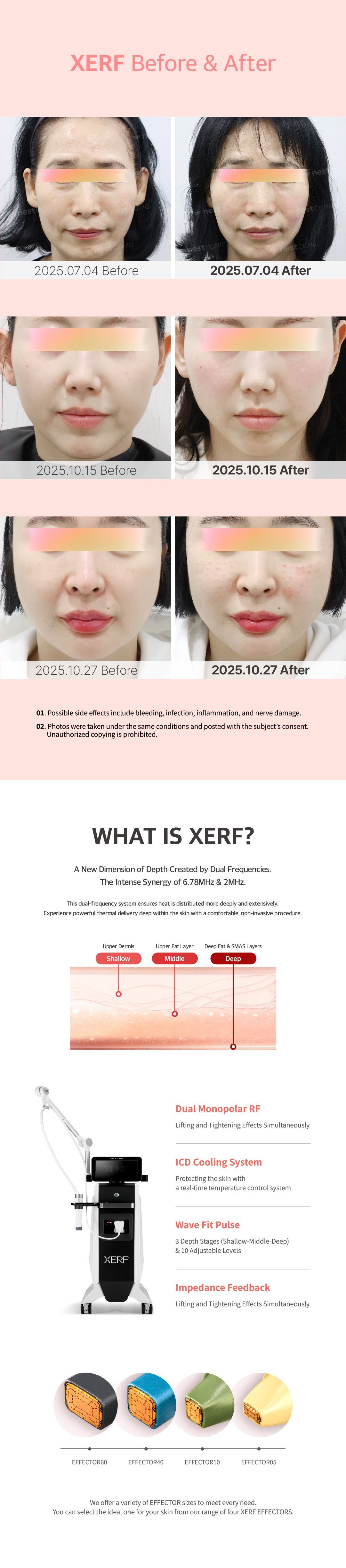
Most patients describe XERF as warm pulses with brief moments of stronger heat rather than sharp pain. The device combines dual-frequency RF (6.78 MHz and 2 MHz) with contact cooling and real-time monitoring to limit surface heat, and the doctor can lower energy or use numbing cream in sensitive areas. Pain tolerance varies, so comfort is adjusted during the session.
Why XERF is designed to be more comfortable
Older monopolar RF devices can build up intense heat at the skin surface. XERF addresses this with several design features:
- Dual-frequency RF (6.78 MHz + 2 MHz) for more controlled energy delivery at different depths
- Real-time impedance monitoring that adjusts energy output automatically
- Contact cooling to protect the skin surface
- Even energy distribution to reduce hot spots
The aim is to heat the deeper collagen-producing layers while keeping the outer skin cooler.
What XERF feels like
Patients commonly describe:
- A warm sensation moving across the skin
- Brief pulses of heat
- Mild tingling
- Temporary warmth after treatment
Pain tolerance differs from person to person. Many patients are comfortable with topical numbing cream or even without it; tell the doctor at any point if an area feels too hot so the energy or pace can be adjusted.
Which areas feel more sensitive?
Areas with thinner skin or bone close to the surface tend to feel warmer:
- Jawline and chin
- Around the mouth
- Temples and forehead
The doctor adjusts depth and energy for each zone to balance comfort and effect.
How XERF compares with Thermage and Ultherapy
Comfort is subjective, but these are the sensations patients typically report:
| Treatment | Typical sensation |
|---|---|
| XERF | Warmth with brief heat pulses |
| Thermage FLX | Stronger, more intense heat |
| Ultherapy | Deeper, sharper sensations from focused ultrasound |
See XERF vs Thermage and XERF vs Ultherapy for full comparisons.
Numbing and recovery
- Topical numbing cream is optional and useful for sensitive patients.
- General anesthesia is not required; XERF is an outpatient treatment.
- Mild redness, warmth or slight swelling usually settles within a few hours.
- Most people return to work the same day; makeup can usually be applied the same or next day.
For a full overview of possible reactions, read XERF side effects explained.
Tips for a more comfortable session
- Before: stay hydrated, avoid heavy alcohol the night before and mention sensitive skin.
- During: speak up about any area that feels too hot so settings can be changed.
- After: moisturize, use sunscreen daily and avoid saunas or intense heat for 24–48 hours if advised.
Reviewed by Dr. Joo Sohee
Representative director of Nest Clinic Gangnam, a doctor-led aesthetic clinic with a female medical team that treats local and international patients. This page is reviewed for medical accuracy; it is general information, not a diagnosis. Treatment plans are decided after an in-person consultation.
Clinic treatment counts as reported by Nest Clinic. About the clinic
Frequently asked questions
Does XERF hurt more than Ultherapy?
Most patients find XERF more comfortable, as it uses RF with integrated cooling, whereas Ultherapy uses focused ultrasound that can feel deeper and sharper.
Is XERF painful around the jawline?
The jawline can feel warmer than other areas because the skin is thinner over bone, but the doctor can adjust settings for comfort.
Can I have XERF without numbing cream?
Many patients do, though topical numbing cream is available for those who are sensitive to heat.
How long does discomfort last after XERF?
Any warmth or tenderness generally settles within a few hours.
Will XERF cause bruising?
Bruising is uncommon because XERF is non-invasive and uses no needles or incisions.
Worried about discomfort? Ask our doctors in Seoul
Send us a photo and your goals — a doctor reviews it and our English-speaking coordinator replies with a personalised plan and price.
4F–5F Seocho Building, 453 Gangnam-daero, Seocho-gu, Seoul
1-min walk from Sinnonhyeon Station Exit 7 (Line 9)
7–10 min from Gangnam Station Exit 10/11
+82-10-4843-2867